
A practical Fatima Optical guide to comfort, protection, and real daily use
At Fatima Optical, we believe the best lenses are the ones that make daily life easier, not just the ones that sound impressive in a brochure.
That is one reason photochromic lenses continue to matter.
For many regular glasses wearers, the day does not happen in one lighting condition. It starts indoors, moves into bright sunlight, shifts back into office light, then out again for errands, commuting, school pickup, or evening walks. That repeated change can make ordinary clear lenses feel limiting and separate sunglasses feel inconvenient. Photochromic lenses remain popular because they help reduce that friction while also offering UV protection and day-to-day convenience.
On FatimaLens.com, the real question is not whether photochromic lenses are interesting technology. The real question is much simpler:
Are they actually worth wearing every day?
For many people, yes.
What photochromic lenses do in real life
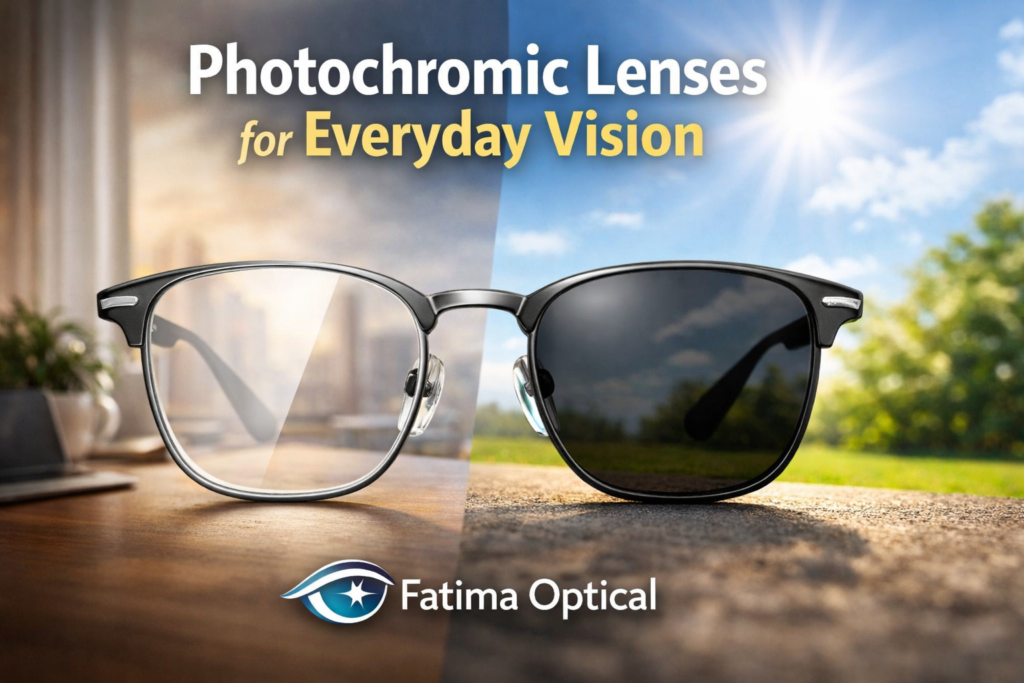
Photochromic lenses are designed to stay clear or nearly clear indoors and darken automatically outdoors, mainly in response to ultraviolet light. When the UV exposure drops, the lens gradually returns toward a lighter state. That basic function is widely established in current ophthalmology and lens guidance.
For the wearer, the benefit feels less technical than that. It feels practical.
You step outside and the lenses adjust.
You come back indoors and they clear again.
You do not need to stop, swap glasses, or reach for a second case every time the light changes.
That ease is what gives photochromic lenses their lasting value.
Why they work well for everyday wear
At Fatima Optical, we see photochromic lenses as a strong everyday option because they support the way many people actually live. The value is not only in sun darkening. It is in how naturally they fit normal routines.
They are especially useful for:
- commuters
- students
- parents
- office workers
- outdoor professionals
- anyone who already wears prescription glasses and wants fewer interruptions
The American Academy of Ophthalmology describes the main appeal clearly: convenience and built-in UV protection without having to remember a separate pair of prescription sunglasses every time you go outdoors.
That is not a minor benefit. For people who wear glasses every day, convenience often determines whether protective eyewear habits actually happen consistently.
The comfort advantage
One of the biggest everyday benefits of photochromic lenses is comfort during indoor-to-outdoor transitions.
Going from shaded interiors into bright sun can cause immediate squinting, visual discomfort, and glare. Adaptive lenses help soften that shift. Instead of forcing the wearer to react to sudden brightness with no protection, the lenses begin responding automatically when exposure changes. Lens guides and medically reviewed vision explainers consistently frame them as useful for smoother light adaptation and all-day wear.
This is especially valuable for people who walk frequently between buildings, spend time near windows, or move between work, transit, and outdoor spaces.
Why the CR-39 angle still matters
Your original draft was smart to highlight CR-39, because many everyday eyewear decisions are still about comfort, clarity, and wearability.
CR-39 remains a well-known lens material because it offers good optical quality and is much lighter than traditional glass lenses. That lighter feel matters during long daily wear. It is one reason standard plastic lenses remain so common in prescription eyewear. Still, the best material can depend on the user’s needs, since some people may be better served by polycarbonate, Trivex, or high-index materials depending on prescription, thickness, and durability priorities.
For Fatima Optical readers, that is the practical takeaway: photochromic performance matters, but lens material matters too.
Who benefits most
Not every lens is ideal for every user, and honest guidance makes the article stronger.
Photochromic lenses are especially helpful for people who:
- wear prescription glasses regularly
- move between indoor and outdoor light several times a day
- dislike carrying a second pair of sunglasses
- want more consistent UV protection
- prefer one pair to do more of the work
Children with prescriptions can benefit as well. Mayo Clinic Health System notes that when children already need corrective eyewear, photochromic lenses can help eliminate the need for a separate pair of sunglasses while still supporting UV protection.
That makes them appealing for families who want a simple, everyday solution rather than more accessories to manage.
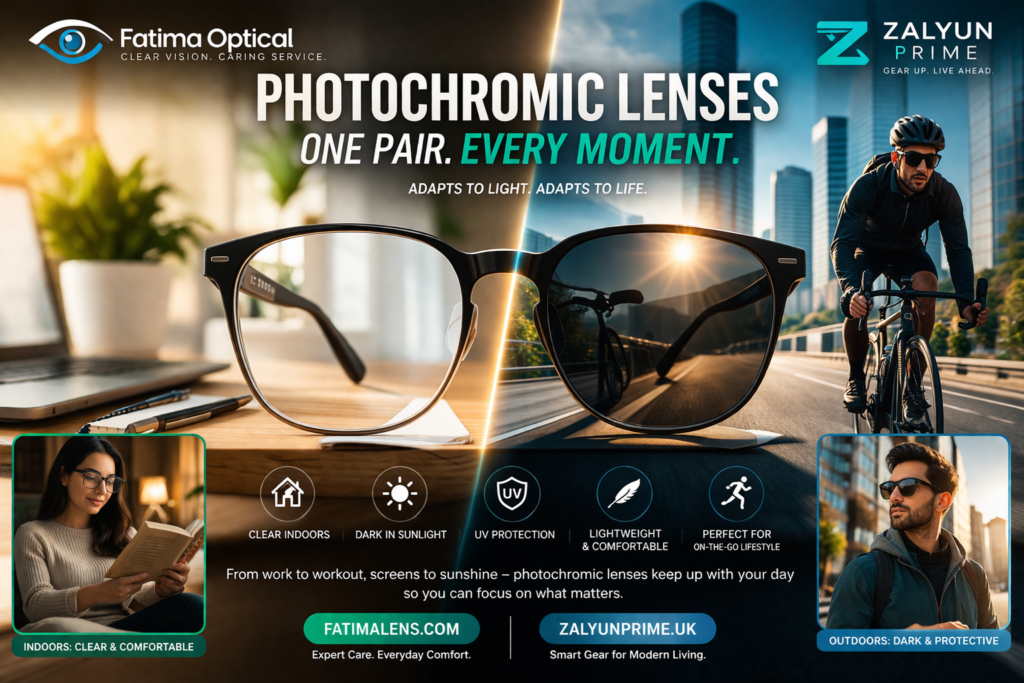
If you want the modern lifestyle and mobility angle of this topic, visit our partner brand Zalyun Prime onZalyunPrime.uk:
Why Photochromic Lenses Fit the Outdoor Tech Lifestyle
What buyers should know before choosing them
A strong article should do more than sell the benefits. It should also explain the limits clearly.
One of the biggest limitations is driving. Many standard photochromic lenses do not darken fully inside a car because the windshield blocks much of the UV light that activates them. That is one of the most important practical facts buyers should know before expecting photochromic lenses to replace driving sunglasses completely. Some newer product lines are designed to improve in-car performance, but standard versions are still generally stronger outdoors than behind a windshield.
Temperature can also affect how the lens behaves. In colder weather, some lenses may darken more deeply and take longer to return toward clear. In warmer conditions, they may clear faster but not always reach the same tint level. That variation is part of the chemistry, not necessarily a defect.
This honesty matters because it helps customers choose the right lens for the right lifestyle.
Are they better than sunglasses?
Not always.
And that is exactly the balanced answer a reader deserves.
Photochromic lenses are not always a full replacement for dedicated sunglasses. If someone spends long hours driving, deals with very strong reflected glare, or wants the darkest possible outdoor tint at all times, dedicated sunglasses may still be the better specialist option.
But that does not reduce the value of photochromic lenses.
It clarifies their role.
They are strongest as versatile everyday eyewear. They are built for people who want convenience, flexibility, and fewer interruptions, not necessarily the most specialized solution for every edge case.
That is why they remain such a practical recommendation for many Fatima Optical customers.
What published buyer experience tends to show
Published buyer feedback around adaptive lenses usually points to the same strengths: comfort, convenience, less eyewear swapping, and the freedom of using one pair more often throughout the day. At the same time, some complaints focus on prescription accuracy, retailer handling, or order quality rather than the core lens idea itself. That difference matters, because it suggests the technology can be genuinely useful even when the retail experience varies.
In plain terms, good lenses still need good fitting, accurate prescriptions, and realistic expectations.
Why Fatima Optical recommends them
At Fatima Optical, we recommend products that make everyday vision simpler.
Photochromic lenses do that well.
They help reduce glare during daily transitions.
They make outdoor movement easier for regular glasses wearers.
They reduce the need to keep switching between clear lenses and sunglasses.
And they fit naturally into the daily lives of people who move through changing light.
They are especially useful for:
- regular prescription wearers
- commuters
- students
- parents
- people with active daily routines
- anyone who wants more flexibility from one pair of glasses
They are less ideal for:
- people expecting maximum tint while driving
- users who need a dedicated heavy-glare solution
- wearers whose routine rarely changes lighting conditions
That is the balanced truth — and balanced truth is what makes content useful.
Final thought
Photochromic lenses are not valuable because they are flashy. They are valuable because they quietly support the way people actually move through the day.
At Fatima Optical, that is exactly the kind of eyewear solution we respect most: practical, comfortable, adaptable, and genuinely helpful.
For the right wearer, photochromic lenses are not just an upgrade.
They are a smarter way to handle everyday vision.
FAQ
What are photochromic lenses?
Photochromic lenses are eyeglass lenses that stay clear or nearly clear indoors and darken automatically in sunlight because they react mainly to ultraviolet light.
Are photochromic lenses good for everyday use?
Yes. They are especially useful for people who wear glasses every day and move often between indoor and outdoor environments.
Do photochromic lenses work in the car?
Many standard versions do not darken fully inside a car because most windshields block much of the UV light needed for activation.
Are CR-39 photochromic lenses still a good choice?
Often yes. CR-39 remains popular because it offers good optical clarity and a lighter feel than glass, though other materials may suit some prescriptions better.
Who benefits most from photochromic lenses?
Commuters, students, parents, outdoor workers, children with prescriptions, and regular glasses wearers who want convenience and UV protection often benefit the most.
Are photochromic lenses a replacement for sunglasses?
Not always. They are best understood as versatile everyday eyewear, while dedicated sunglasses may still be better for driving or very intense glare.
About Fatima Optical:
Fatima Optical shares practical eyewear guidance, everyday vision advice, and lens education designed to help readers choose solutions that are comfortable, useful, and easy to live with.
Also read on ZalyunPrime.uk
Why Photochromic Lenses Fit the Outdoor Tech Lifestyle
A reader-friendly look at how adaptive lenses suit commuting, cycling, hybrid work, travel, and modern daily movement.
Pingback: Why Photochromic Lenses Fit the Outdoor Tech Lifestyle - Zalyun Prime